 English






Ischemic heart disease is the "leading killer" in the Middle East. Middle Eastern merchants are recommended to undergo coronary screening before the Canton Fair, and DOVECURE medical accompanying services can provide full assistance.
Ischemic Heart Disease — The "Leading Killer" in the Middle East: A Coronary Screening Is Worth Doing Before the Canton Fair
For Middle Eastern exhibitors about to embark on the 140th Canton Fair, Guangzhou is not only a core window to expand global business opportunities, but also a rare opportunity to balance business travel and health management. However, many may not have noticed that ischemic heart disease (IHD) has long ranked among the top causes of death among residents in the Middle East, becoming a chronic health threat of key concern in the local public health field.
According to authoritative international epidemiological statistics, in 2021, the age-standardized prevalence of ischemic heart disease in the Middle East and North Africa reached 6404.8 per 100,000 population, the age-standardized mortality rate was 202.8 per 100,000, and the disability-adjusted life year rate was 4023.2 per 100,000. That means nearly 203 people out of every 100,000 population in the Middle East and North Africa die from ischemic heart disease.
At the national level, the situation in Saudi Arabia is particularly severe. Relevant studies show that the average mortality rate of ischemic heart disease for Saudi men is 133.25 per 100,000, and 87.84 per 100,000 for women, with the mortality rate significantly higher in men than in women. In the United Arab Emirates, cardiovascular diseases account for about one-third of all deaths, and cardiologists point out that nearly 50% of myocardial infarction patients in the UAE are under 50 years old.
These figures are not cold statistics, but a reminder to every busy business traveler: heart health risks may be right around you.
The "superposition effect" of high-pressure business trips: every link increases the burden on the heart
Many Middle Eastern merchants who travel frequently to international exhibitions are already accustomed to the non-stop business rhythm. Before the exhibition, they stay up late to prepare exhibits and quotation sheets; they sit still for more than ten hours on long-haul flights; after arrival, they attend successive business banquets where high-oil and high-fat local cuisines become their daily meals during the trip, coupled with continuous mental stress from negotiations and discussions — all of these are clear inducing factors for ischemic heart disease.
The risks of long-haul flights are especially worthy of vigilance. Studies show that among cases of pulmonary embolism occurring after long flights, 78% of patients already had a high risk of thrombosis before boarding. A prospective controlled cohort study further found that among passengers with flight duration ≥8 hours, all confirmed cases of venous thromboembolism were concentrated in individuals with clear pre-existing risk factors. This means that if you already have cardiovascular risk factors — such as obesity, smoking, hypertension or diabetes — the risks brought by long-haul flights will multiply.
The Middle East is precisely one of the regions with the heaviest burden of cardiovascular metabolic risk factors in the world. Studies show that metabolic risk factors collectively contribute to nearly half of the disability-adjusted life year loss in the Middle East and North Africa. Among patients hospitalized for atherosclerotic cardiovascular disease in the region, the smoking rate is as high as 54.0%, and the prevalence of diabetes is 35.4%. When these risk factors are superimposed on high-intensity business trips, the pressure on the heart can be imagined.
A real warning: when myocardial infarction strikes at the last moment of your business trip
In June 2025, a 49-year-old Egyptian merchant suddenly felt severe chest pain while waiting for a return flight at an international airport in China. Airport staff rushed him to a local hospital within one hour. Remote diagnosis confirmed that he had suffered an acute ST-segment elevation myocardial infarction — a serious and life-threatening heart attack. Despite language barriers, doctors coordinated with his Chinese friend and his wife in Egypt to obtain surgical consent, completed the coronary stent operation in only 48 minutes, and found that his right coronary artery was completely blocked.
The merchant’s subsequent remarks were touching: "I have never seen such a high level of medical service, thank you for saving my life." Doctors specially advised international travelers with heart problems to undergo physical examinations before long-distance trips and carry their emergency medical information with them.
This case is not an isolated one. Many Middle Eastern merchants are usually busy with business in their home countries and have no time to arrange systematic heart screening. They often do not realize that hidden health risks have quietly accumulated until discomfort symptoms such as chest tightness and chest pain appear.
The gap period before the Canton Fair is the golden window for screening
In fact, the gap period before the opening of the Canton Fair is a good time to undergo a targeted heart health check. Guangzhou has a mature foreign-related medical service system, and the cardiovascular departments of many tertiary hospitals have rich experience in receiving international patients.
Guangzhou currently has 48 tertiary hospitals and 10 national top 100 hospitals, with strong strength in the diagnosis and treatment of characteristic diseases. Some hospitals are equipped with foreign-related high-end medical outpatient departments and inpatient wards, with a nurse-to-patient ratio exceeding 1.5:1, reaching a high allocation level. Recently, Guangzhou has also launched 12 innovative measures to support the development of international medical services, linking multiple pilot international medical service hospitals to provide overseas patients with full-process services covering visa assistance, remote pre-consultation, multilingual translation, travel accommodation and post-discharge follow-up.
Coronary artery calcium score: a fast and accurate "searchlight" for heart risk
Among cardiac screening items, the coronary artery calcium score (CAC score) is a test worthy of special attention. It quickly evaluates the degree of coronary artery calcification through low-dose CT, and is a cardiovascular risk stratification tool recommended by international guidelines, especially suitable for asymptomatic people with moderate risks.
A large-scale registry study involving 10,857 patients shows that the negative predictive value of CAC=0 for excluding obstructive coronary heart disease is as high as 98.2%, and the negative predictive value for high-risk coronary heart disease reaches 99.4%. This means that if the CAC score is zero, severe coronary stenosis can be largely ruled out. The conclusion of this study clearly points out that this result supports the inclusion of CAC testing in the early triage of chest pain patients and serves as a "gatekeeper" for further cardiac examinations.
For business travelers who travel frequently, the coronary artery calcium score test is fast and non-invasive. Combined with items such as color Doppler echocardiography, a systematic heart health assessment can be completed in a relatively short time.
DOVECURE medical accompanying services: making health management no extra burden on business trips
Many foreign merchants who come to Guangzhou for the first time often worry about complicated procedures and poor communication when facing an unfamiliar medical environment. Making a medical trip plan in advance will not only delay the progress of business preparation, but also help identify hidden heart health risks, so as to avoid sudden discomfort during the busiest stage of the exhibition and affect important business negotiation arrangements.
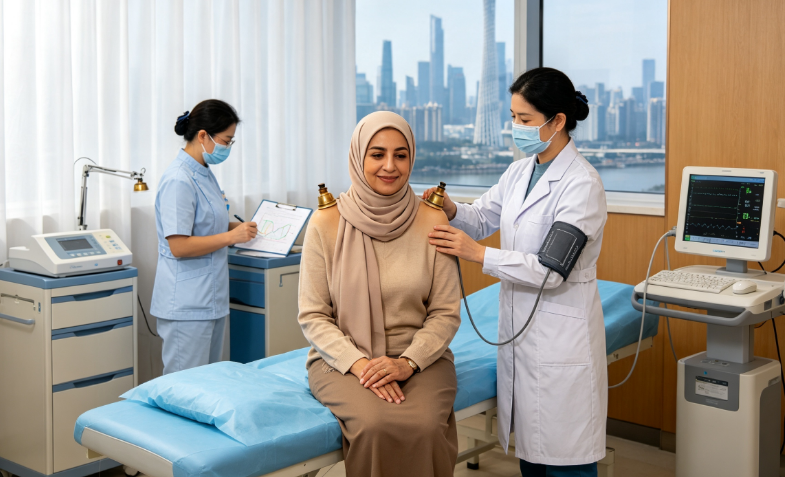
For Middle Eastern merchants coming to Guangzhou during the Canton Fair, DOVECURE medical accompanying services can assist in arranging targeted screening items such as color Doppler echocardiography and coronary artery calcium score. From pre-hospital appointment arrangement, private car transfer, to full-process bilingual accompanying consultation and medical report translation, every medical link has dedicated personnel to connect. You do not need to spend extra time in an unfamiliar hospital, and can efficiently complete a professional heart health assessment to build a solid health defense line for the entire Canton Fair business trip.
At present, Guangzhou has formed a mature foreign-related medical service chain. DOVECURE medical accompanying services cover multilingual communication, medical guidance, report interpretation and other links, providing foreign patients with a convenient medical experience. A highly efficient heart screening may only take half a day, but it can build a solid health defense line for the entire Canton Fair business trip.
Business opportunities are worth fighting for with all your strength, but health deserves more advance protection. Before you set off for Guangzhou, you might as well arrange a professional "physical examination" for your heart — this is not only responsible for yourself, but also for the family expectations behind every business deal.

.png)


.png)