 English



The 140th Canton Fair: Middle Eastern businessmen are wary of the "deadly combination" of obesity and cardiovascular disease. Body fat analysis+carotid ultrasound early screening, DOVECURE one-stop physical examination and conditioning.
Obesity and Cardiovascular Disease: A "Deadly Combination" for Middle Eastern Merchants
As the 140th Canton Fair approaches, purchasing merchants from across the Middle East will once again begin arriving in Guangzhou. In business circles across Dubai, Riyadh and Doha, a saying goes around — "The bigger the business, the bigger the belly." What may sound like a joke conceals a serious health reality: the Middle East is one of the world's regions with the highest rates of obesity and cardiovascular disease, and this "deadly combination" of obesity and cardiovascular disease is quietly threatening every Middle Eastern merchant constantly occupied with business entertainment.
I. The Middle East: A Double Hotspot for Obesity and Cardiovascular Disease
According to World Health Organization data, adult obesity rates in the Middle East and North Africa have exceeded 30%, and in some Gulf countries they are as high as over 40% — meaning nearly one out of every two adults is overweight or obese. Meanwhile, ischemic heart disease (IHD) has ranked first in the Middle East's leading causes of death for many consecutive years, and the prevalence of cardiovascular diseases such as hypertension, hyperlipidemia, coronary heart disease and stroke continues to rise.
These two sets of data are no coincidence. Extensive medical research has confirmed that obesity is an independent risk factor for cardiovascular disease. For Middle Eastern merchants, this association is particularly pronounced:
High-calorie traditional diets (grilled meats, fried foods, desserts, sugary beverages), car-dependent lifestyles, long sedentary hours in business work, and frequent business banquets and social entertainment... These habits layer upon one another, causing weight and waist circumference to creep up imperceptibly, while planting countless "time bombs" in the cardiovascular system.
Even more alarming is that for many Middle Eastern merchants, obesity is not "overall body fat" but "central obesity" — meaning a large belly and high visceral fat. This "apple-shaped figure" is far more dangerous than a "pear-shaped figure," because visceral fat directly releases inflammatory factors and lipotoxic substances that continuously damage the vascular endothelium and accelerate the progression of atherosclerosis.
II. Why Is Obesity a "Silent Killer" for the Cardiovascular System?
Many people think "being a bit overweight is just about appearance, it doesn't affect health." This is an extremely dangerous misconception. The damage obesity causes to the cardiovascular system is comprehensive and multi-layered:
First, obesity causes the heart to "overwork." For every 10 kilograms of weight gained, the body requires several extra kilometers of blood vessels to supply blood, and the heart must work twice as hard to pump blood throughout the body. Long-term overloading leads to myocardial hypertrophy and cardiac enlargement, eventually developing into heart failure. Research shows that obese people face more than twice the risk of heart failure compared to people of normal weight.
Second, obesity drives the "three highs": high blood pressure, high blood lipids and high blood sugar. Among obese people, the prevalence of hypertension is 2–3 times higher than that of people of normal weight, hyperlipidemia prevalence is 2–4 times higher, and the risk of type 2 diabetes is 5–7 times higher. The "three highs" are precisely the three major culprits of atherosclerosis. Working together, they gradually harden, embrittle and narrow blood vessel walls, eventually leading to blockage or rupture.
Third, obesity directly damages blood vessels. Visceral fat cells release large amounts of inflammatory factors, putting blood vessels in a chronic inflammatory state, accelerating lipid deposition on vessel walls and forming atherosclerotic plaques. These plaques are like "garbage mountains" inside blood vessels — once they rupture, they trigger thrombosis; when it blocks the heart, it causes a myocardial infarction, and when it blocks the brain, it causes a stroke.
For Middle Eastern merchants, the most terrifying thing is not obesity itself, but the "chain reaction" it triggers — a single problem of obesity brings along hypertension, hyperlipidemia, hyperglycemia, fatty liver, high uric acid... These problems appear in a bundle, and their damage to the cardiovascular system produces a superimposed effect of 1+1>2.
III. Two Key Screenings to Nip Risks in the Bud
Many Middle Eastern merchants, when coming to Guangzhou for check-ups, only focus on the number on the scale, thinking "if my weight is not超标, everything is fine." But in reality, for the same weight, different fat distributions mean vastly different health risks. To truly assess the cardiovascular risks posed by obesity, the following two examinations are essential:
1. Body Composition Analysis: Don't Just Look at Weight — Look at Where the Fat Is "Hiding"
A regular scale can only tell you how much you weigh, but a body composition analyzer can precisely measure key indicators such as body fat percentage, visceral fat level, muscle mass and basal metabolic rate. Two people both weighing 80 kilograms — one with more muscle and less fat, and the other with more fat, especially excessive visceral fat — face completely different health risks.
For middle-aged male Middle Eastern merchants, waist circumference and visceral fat level are more important warning indicators than body weight. For men, a waist circumference exceeding 90 cm and a visceral fat level above 10 significantly raise cardiovascular disease risk. Many people look like they have normal weight, but only discover after a body composition analysis that their visceral fat is already severely excessive — this "invisible obesity" is more dangerous than visible overweight.
2. Carotid Ultrasound: Detecting Vascular Risks 5–10 Years in Advance
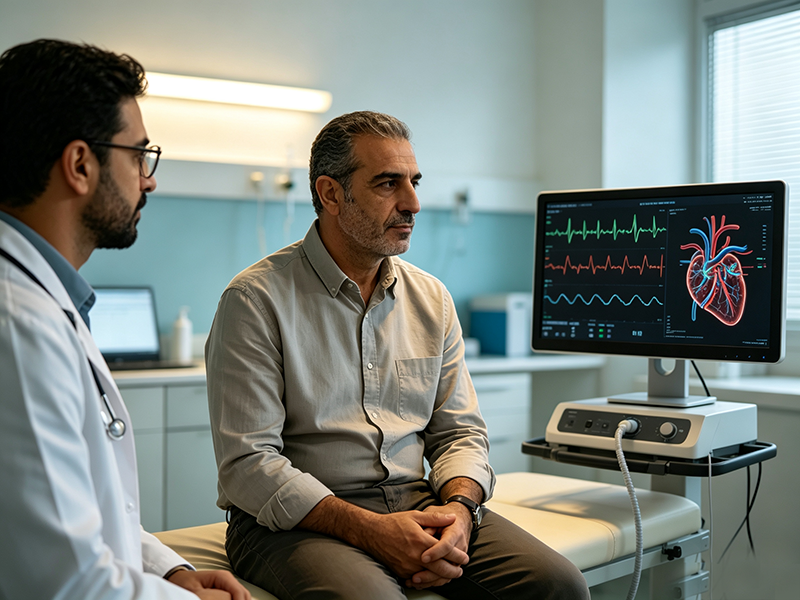
The carotid arteries are the "window" to the body's entire vascular system. Because the carotid arteries are located superficially and easy to observe, a carotid ultrasound examination can clearly show whether the vessel walls have thickened, whether plaques have formed, and the degree of vascular stenosis. The degree of carotid atherosclerosis essentially reflects the level of systemic arterial sclerosis.
Many people whose blood lipid indicators are only slightly elevated during check-ups think "it's not a big problem," but upon carotid ultrasound examination, multiple plaques are already discovered. Studies show that the appearance of carotid plaques precedes clinical events such as coronary heart disease and stroke by 5–10 years. That means, through carotid screening, we have a full 5–10 year window for intervention and reversal — provided you get this examination done first.
For high-risk groups such as Middle Eastern merchants with high prevalence of obesity and hyperlipidemia, an annual carotid ultrasound is an extremely cost-effective health investment.
IV. What to Do If Problems Are Found? Weight Loss Is the Best "Prescription"
If a body composition analysis shows you have excessive body fat percentage and high visceral fat, or if a carotid ultrasound detects early plaques, there is no need to panic. Weight loss is the most effective way to improve obesity-related cardiovascular risks — even more effective than many medications.
Studies show that a 5%–10% reduction in body weight can bring about comprehensive improvements in blood pressure, blood lipids and blood sugar; losing more than 10 kilograms can even slow or reverse the progression of carotid plaques.
But weight loss is not easy, especially for Middle Eastern merchants constantly busy with business and having irregular diets. "Controlling your mouth and moving your legs" sounds simple but is hard to practice. This is where TCM wellness demonstrates its unique value.
In Traditional Chinese Medicine, the core pathogenesis of obesity is "spleen deficiency with dampness excess." Through syndrome differentiation and treatment, using methods such as acupuncture, moxibustion, tuina and Chinese herbal conditioning can strengthen the spleen, dispel dampness, regulate metabolism and improve physical constitution. Many Middle Eastern merchants, after experiencing TCM weight loss conditioning, have reported: "No need for deliberate dieting — with a few sessions of acupuncture and tuina plus dietary guidance, weight starts to drop gradually, and sleep, energy and digestive function also improve along with it."
Compared with simple dieting or strenuous exercise, TCM weight loss is gentler, more sustainable, and more suitable for the lifestyle of business people — no need to carve out large blocks of time for the gym. Using spare time during the Canton Fair to do a few sessions of acupuncture and tuina conditioning can kickstart a healthy weight loss cycle.
V. Get Your Check-Up Done at the Canton Fair — DOVECURE Handles Everything in One Stop
For Middle Eastern merchants coming to Guangzhou for the first time, finding hospitals, choosing packages and getting examinations done on their own is indeed time-consuming and laborious. But DOVECURE, a professional institution deeply engaged in foreign-related medical services in Guangzhou for many years, can help you arrange everything properly.
DOVECURE can directly book specialized health check-up packages at Meinian Onehealth, covering core cardiovascular risk indicators such as body composition analysis, carotid ultrasound, blood lipids, blood sugar and homocysteine, with centers covering key districts including Tianhe, Yuexiu and Panyu. Throughout the check-up, Arabic/English bilingual medical companions are provided, accompanying you from package explanation and examination guidance to result communication. All reports are provided in Chinese-Arabic/Chinese-English bilingual versions, making it convenient to hand over to your family doctor for continuous follow-up after returning home. On the day of the check-up, dedicated vehicles are arranged for airport transfers and round trips from the exhibition hall, with routes and timing seamlessly connected so as not to delay your exhibition schedule at all. If the examination indicates elevated body fat or metabolic abnormalities, TCM constitution identification and wellness conditioning can be further connected, with professional personnel providing gentle and sustainable weight management plans based on individual constitution, including dietary advice, medicinal herbal teas, moxibustion, tuina and exercise guidance, helping merchants continue their weight loss plans after returning to the Middle East. If you need to extend your stay in China to complete examinations and follow-up conditioning, DOVECURE can also provide medical tourism visa coordination services, making the entire health journey worry-free.
No matter how big your business grows, a healthy body is needed to support it. Take the opportunity of attending the 140th Canton Fair in Guangzhou to get a body composition analysis and carotid screening, give your blood vessels a "comprehensive check-up," and nip the cardiovascular risks brought by obesity in the bud.
.png)
.png)