تفاصيل القسم
I. Department Development History and Structural Composition
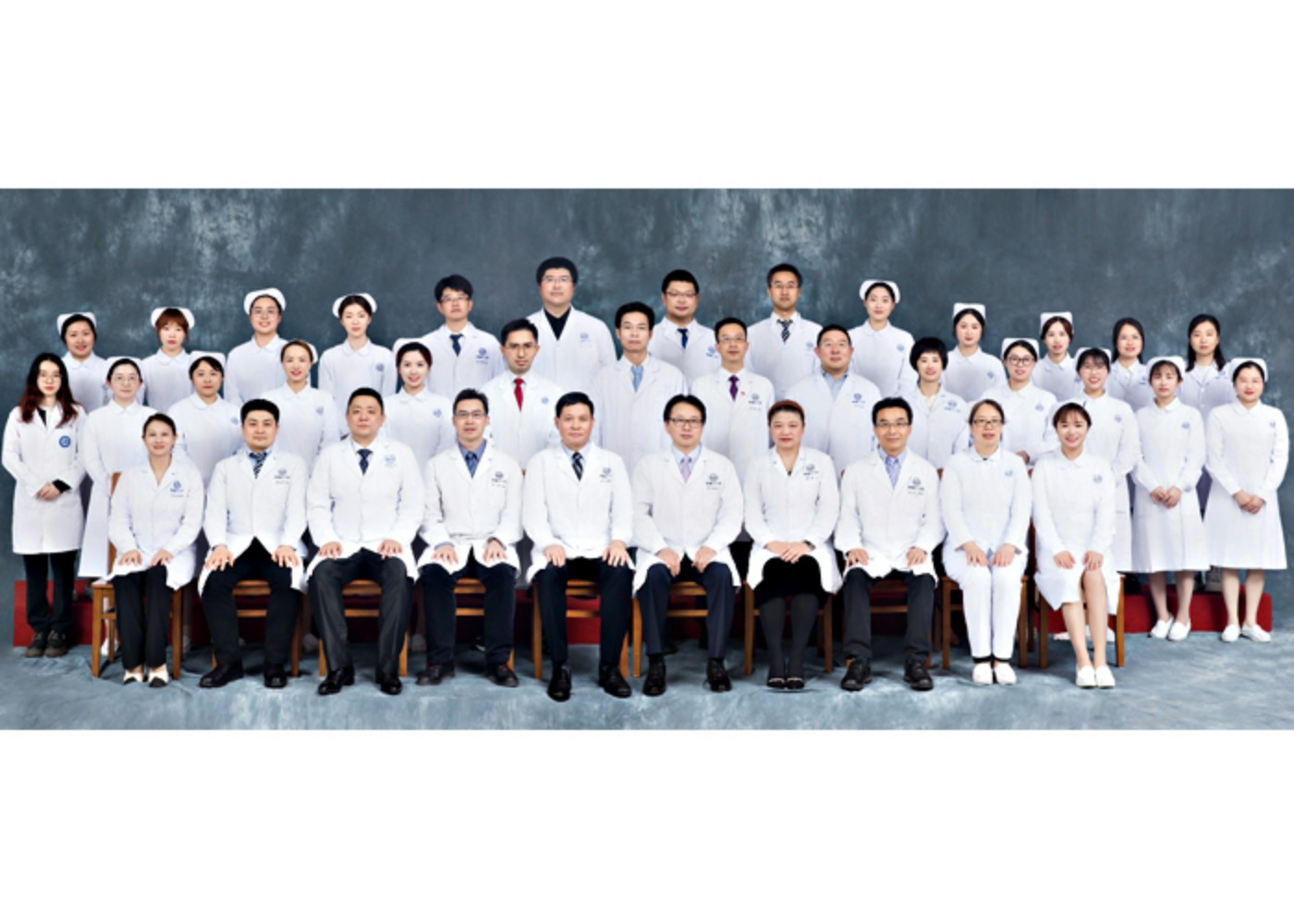
The Department of Tumor Intervention at Renji Hospital Affiliated to Shanghai Jiao Tong University School of Medicine was established in August 2013. It is one of the earliest specialized departments in China dedicated to the clinical practice and research of tumor interventional therapy. In 2019, it became one of the first batch of National Tumor Ablation Therapy Technology Training Bases of the Chinese Medical Doctor Association. The department currently comprises two wards (East and South), with 75 beds (50 in the East Campus and 25 in the South Campus), 18 physicians (including 4 chief physicians, 5 associate chief physicians, 7 attending physicians, and 2 resident physicians), and 3 full-time research and logistics staff (including 1 Ph.D. in bioinformatics). There are 4 master's supervisors, and over 60% of physicians hold a medical doctoral degree.
Since its establishment, the Department of Tumor Intervention at Renji Hospital has defined its development direction and goals, striving for simultaneous advancement in both clinical practice and scientific research, with equal emphasis on basic, translational, and clinical research, and aiming to make its sub-specialties larger, more refined, and stronger. Adhering to a clinical diagnosis and treatment-oriented approach, the department emphasizes clinical translational research as well as original, cutting-edge, and leading research, endeavoring to build a research-oriented tumor interventional therapy department that excels in clinical practice and is strong in scientific research. Meanwhile, the department focuses on sub-specialty development, implementing a professor-responsibility system based on disease types and treatment techniques, striving to make clinical work larger, more refined, and stronger.
After 10 years of arduous efforts, the Department of Tumor Intervention has begun to take shape in terms of disciplinary construction and has gradually formed a relatively reasonable clinical and research system. In the past three years, the average annual number of discharged tumor patients was 7,129, and the average annual number of tumor interventional procedures and operations completed was 11,726, including 7,620 cases of Level III or above interventional procedures such as local tumor ablation, vascular intervention, particle implantation, and stent implantation.
II. Clinical Characteristic Treatments of the Department:
(I) Local Tumor Ablation Therapy
1. Possession of all mainstream ablation devices and all adjunctive treatment modalities:
The Department of Tumor Intervention possesses various mainstream ablation therapy devices, including radiofrequency, microwave, laser, cryoablation, irreversible electroporation (NanoKnife), and Kangbo knife, along with comprehensive adjunctive treatment modalities. These mainly include:
(1) Local ablation of benign and malignant tumors under color ultrasound (including contrast-enhanced ultrasound) guidance.
(2) CT-guided percutaneous ablation. Mainly used for lung tumors and some liver, bone, and other tumors.
(3) Open magnetic resonance-guided ablation or particle implantation, etc.
(4) Laparoscopy-assisted local ablation of liver cancer, kidney cancer, etc.
(5) Open surgical approach for tumor ablation and ablation combined with surgical resection for multiple liver tumors.
2. Local tumor ablation therapy projects already carried out by the department
(1) Various types of primary and metastatic liver cancer. Among these, local ablation of large liver cancer, multiple liver cancer, and liver cancer at high-risk locations is a major feature of the department.
(2) Benign tumors such as large hepatic hemangioma and focal nodular hyperplasia.
(3) Thoracic tumors such as pulmonary ground-glass opacities, early-stage small lung cancer, and advanced lung cancer that is unresectable or the patient is unwilling to undergo resection.
(4) Benign tumors of the thyroid and breast, such as thyroid adenoma and breast fibroadenoma. These procedures leave almost no scar, achieving results similar to surgical resection while avoiding the aesthetic impact of surgical resection.
(5) Peritoneal seeding tumors and retroperitoneal tumors.
(6) Bone and soft tissue metastases.
(7) Lymph node metastases at the hepatic hilum, retroperitoneum, and neck, etc.
(8) Renal and adrenal tumors.
(II) Transcatheter Arterial Chemoembolization and Other Vascular Interventional Therapies for Tumors
The department extensively carries out vascular interventional therapies such as transcatheter arterial chemoembolization and continuous arterial infusion chemotherapy for malignant tumors of solid organs including the liver and lungs. Embolization procedures for benign diseases such as uterine fibroids, hepatic hemangioma, and splenomegaly with hypersplenism. Various emergency interventional procedures under DSA, such as hemostasis, vascular occlusion after liver transplantation, and TIPS, etc.
(III) Radioactive Particle Implantation for Tumors (Brachytherapy or Internal Radiation Therapy)
Widely applied for the effective treatment of dozens of high-risk location tumors, including lung tumors at high-risk locations, portal vein tumor thrombus or bile duct thrombus in liver cancer, bone metastases, peritoneal seeding metastases, and pelvic tumors.
(IV) Intraluminal Stent (Including Particle Stents) Implantation for Biliary, Esophageal, Gastrointestinal, and Airway Tracts
(V) Other Interventional Therapies or Procedures
1. Totally implantable venous access port implantation.
2. Vertebroplasty.
3. Tumor puncture biopsy.
4. Various puncture and drainage procedures.
III. Scientific Research Work:
Over the 10 years since its establishment, the department has undertaken and completed multiple research grant projects, including more than 40 research projects from the National Natural Science Foundation of China, the Ministry of Science and Technology of China, the Shanghai Science and Technology Commission, the Shanghai Municipal Education Commission, and other sources. Meanwhile, the department has been conducting more than 10 basic or clinical translational research projects in collaboration with relevant laboratories and enterprises, and has participated in over 20 single-center or national multi-center clinical studies on drugs or devices. As first and/or corresponding author, the department has published 143 papers in Chinese and English journals including Nature, Sci Transl Med, Cell Res, and Clin Cancer Res (including 87 first/corresponding author SCI papers, with the highest IF of 50.0), and has published 36 SCI papers as first author or co-author. The department has served as editor-in-chief, associate editor-in-chief, or contributing editor for 12 monographs, applied for 6 national utility model patents and 3 invention patents. Additionally, the department has established and improved clinical databases, follow-up databases, and tumor biobanks, laying a solid foundation for subsequent clinical and basic research.


 العربية