Department Details
The Department of General Surgery at Renji Hospital, Shanghai Jiao Tong University School of Medicine, was founded in 1952 and is one of the earliest medical schools and departments in China to establish a general surgery discipline. The department was founded by outstanding surgeons of the older generation, including Lan Xichun, Dong Fangzhong, and Zhou Xigeng. It grew under the dedication of predecessors such as Kuang Yaolin, Zhu Renwei, Shi Weijin, Wang Pingzhi, Chen Zhiping, and Zhang Baigen, and further developed and expanded under the leadership of Directors Wu Zhiyong and Cao Hui, achieving leapfrog progress and development especially during the "12th Five-Year Plan" and "13th Five-Year Plan" periods. In 2013, the Department of General Surgery completed the adjustment of its sub-specialty structure, and the Division of Gastrointestinal Surgery was formally established, marking a solid step forward on the path of deepening, refining, and strengthening specialization. At present, the Renji Gastrointestinal Surgery Division is a National Key Clinical Specialty of the Ministry of Health, a Laparoscopic Surgery Training Base of the Chinese Medical Doctor Association, and a Colorectal Cancer Diagnosis and Treatment Center of Shanghai Jiao Tong University School of Medicine.
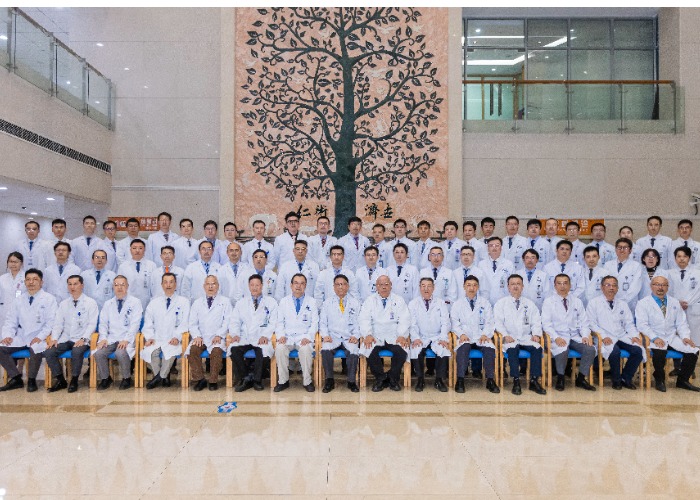
The department has 3 wards across the East, West, and South campuses, with 200 authorized beds (94 in the East Campus, 76 in the West Campus, and 30 in the South Campus). The Gastrointestinal Surgery Division has 56 personnel (55 physicians plus 1 secretary), including 26 with senior professional titles and 20 with intermediate professional titles; 48 hold doctoral degrees and 7 hold master's degrees, forming a specialized team with a reasonable educational structure, a complete talent echelon, and rich clinical experience. In 2021, the outpatient and emergency volume was 160,000, and in 2022, it was 130,000. Nearly 10,000 various surgeries are completed, with Grade III and IV surgeries accounting for the vast majority, including more than 3,500 surgeries for gastrointestinal malignant tumors, ranking among the top in Shanghai. At the same time, Renji Gastrointestinal Surgery Division established a standardized MDT diagnosis and treatment system relatively early in China, forming an integrated service platform and full-process management system covering tumor prevention, diagnosis, treatment, and rehabilitation. The number of patients with difficult and complex gastrointestinal tumors served from all over the country has increased year by year, creating influence and brand effects.
The Renji Gastrointestinal Surgery Division consists of the Gastrointestinal Disease Specialty Group, the Colorectal and Anal Disease Specialty Group, and the Portal Hypertension Specialty Group. The Gastrointestinal Disease Specialty Group highlights standardized, normalized, minimally invasive, and individualized comprehensive diagnosis and treatment of gastric cancer and gastrointestinal stromal tumors, and features minimally invasive treatment of gastrointestinal tumors, rational diagnosis and treatment of small bowel diseases, diagnosis and treatment of acute abdominal diseases of the digestive tract, and traditional and minimally invasive treatment of common diseases such as appendicitis and hernia. The Colorectal and Anal Specialty Group features the treatment of colorectal tumors with an advanced concept combining minimally invasive and traditional approaches, and the diagnosis and treatment of intestinal polyps, intestinal obstruction stents, colorectal inflammatory diseases, and anal functional diseases under fiber colonoscopy. The treatment of portal hypertension features pericardia devascularization, splenorenal venous shunt, and combined surgery. In recent years, the department has actively promoted the vigorous development of minimally invasive surgery for gastrointestinal tumors, among which laparoscopic and robotic surgeries account for about 40%, ranking among the leading positions in the city. It has become an important collaborating unit of the Chinese Laparoscopic Gastrointestinal Surgery Study Group (CLASS), has been invited to participate in the full series of CLASS multicenter prospective randomized controlled clinical studies, and has led, as the lead unit, the first domestic multicenter clinical study of laparoscopic surgery for gastrointestinal stromal tumors (CLASS-06). At the same time, as a clinical center in China that carried out gastric function-preserving surgery relatively early, it has accumulated the largest number of LAPPG surgical cases and clinical database in China. In addition, the clinical diagnosis and treatment of gastrointestinal stromal tumors is also distinctive and has brand effects, and it has become a highly influential and reputable GIST diagnosis and treatment center in China. Its research and diagnostic and treatment experience have been invited to be reported at major international conferences such as the International Gastric Cancer Congress, the World Congress of Endoscopic Surgery, the Annual Meeting of the Japanese and Korean Gastric Cancer Associations, and the China-Japan-Korea Gastric Cancer Laparoscopic Joint Conference. In terms of colorectal cancer surgery, the proportion of laparoscopic minimally invasive procedures has exceeded 60%. Since the first Da Vinci robot-assisted combined resection of colorectal cancer and metastatic lesions was performed in 2014, more than 300 Da Vinci robotic surgeries have been completed to date, ranking among the top in Shanghai. Since 2015, as one of the first MDT clinics in the hospital, through the unremitting efforts of the colorectal cancer MDT members, the proportion of neoadjuvant chemoradiotherapy for low rectal cancer has been greatly increased, and the postoperative local recurrence rate has been significantly reduced, with markedly improved efficacy. In 2017, transanal total mesorectal excision (TaTME) combined with the Da Vinci robot was carried out for patients with ultra-low rectal cancer, perfectly combining oncological radicality with the feasibility of sphincter preservation, representing the highest level and development trend of current rectal cancer surgery. At the same time, Renji Gastrointestinal Surgery Division has also been invited to participate in multiple domestic multicenter prospective randomized controlled studies on laparoscopic low rectal cancer surgery, laparoscopic rectal cancer surgical approach, and the extent of laparoscopic right hemicolectomy dissection.
Against the background of increasingly frequent international exchanges, the department maintains long-term friendly cooperative relations with the Cleveland Clinic in the United States, Heidelberg University in Germany, Friedrich-Alexander-Universität Erlangen-Nürnberg in Germany, the University of Verona in Italy, Seoul National University Hospital in South Korea, the National Cancer Center Hospital in Tokyo, Japan, and Tohoku University Hospital in Japan. In the past 5 years, nearly 20 outstanding young physicians have been selected to these world-class medical centers for more than one year of advanced study or clinical specialized technical training.
Talent cultivation and reserve are the foundation for the sustainable development of the discipline. Attaching importance to the construction of a talent echelon has always been a historical tradition of Renji Gastrointestinal Surgery Division. In recent years, the department has obtained multiple talent training projects, including Shanghai Leading Talent, Shanghai Outstanding Academic Leader, the Second Shanghai Renxin Physician—Outstanding General Surgery Specialist Physician Award, the title of "National Famous Doctor - Outstanding Contribution," the Shanghai Jiao Tong University "Teaching and Educating" Award, the Shanghai Municipal Health and Family Planning Commission Hundred-Person Program, the Shanghai Young Physician Training Funding Program, and the National Hundred Young Surgeons Climbing Talent Program. With the excellent scientific research platforms of Shanghai Jiao Tong University School of Medicine and Renji Hospital, and relying on the strong support of the Shanghai Cancer Institute and the Shanghai Institute of Immunology, the basic translational research and the gastrointestinal surgery clinical diagnosis and treatment team have achieved good integration and obtained excellent scientific research results. Since 2013, a total of 27 National Natural Science Foundation of China projects and nearly 50 projects at various levels, including Municipal Science and Technology Commission funds, Health and Family Planning Commission research funds, and Shenkang Three-Year Action Plan projects, have been applied for and obtained; nearly 200 SCI papers have been published; and clinical research results have successively won the Second Prize of the National Science and Technology Progress Award, the Third Prize of the Chinese Medical Science and Technology Award, the Third Prize of the Shanghai Science and Technology Progress Award, the Second Prize of the Shanghai Medical Science and Technology Award, and the First Prize of the Shanghai Integrated Traditional Chinese and Western Medicine Science and Technology Award.
Renji Gastrointestinal Surgery Division is currently a postdoctoral, doctoral, and master's degree site of Shanghai Jiao Tong University School of Medicine, with 3 doctoral supervisors and 7 master's supervisors. In recent years, it has trained more than 30 doctoral and master's students, with multiple graduate students currently enrolled. As the main discipline undertaking the surgery teaching and research section of Renji Clinical Medical College, Gastrointestinal Surgery Division is responsible for the main teaching tasks of surgery for undergraduate students majoring in clinical medicine. At the same time, the department is also a national key professional base for standardized residency training and a national-level standardized specialist training base.
Renji Gastrointestinal Surgery Division will always uphold the professional belief of "benevolent art saves the world," take solving the diagnosis and treatment of major and difficult clinical diseases as its starting point, adhere to the discipline construction concept of standardization, normalization, refinement, minimally invasive approaches, and comprehensiveness, take clinical translational research as the guide, strengthen the construction of the talent echelon, cultivate discipline-leading talents, establish a multidisciplinary comprehensive treatment model and clinical pathways, maintain and develop the domestic leading position of the gastrointestinal specialty, base itself in Shanghai, radiate across the country, and move toward the international stage, with the goal of building itself into a domestic first-class clinical diagnosis and treatment center with distinctive professional characteristics, first-class medical quality, and coordinated development of medical care, teaching, and research.

 English