Department Details
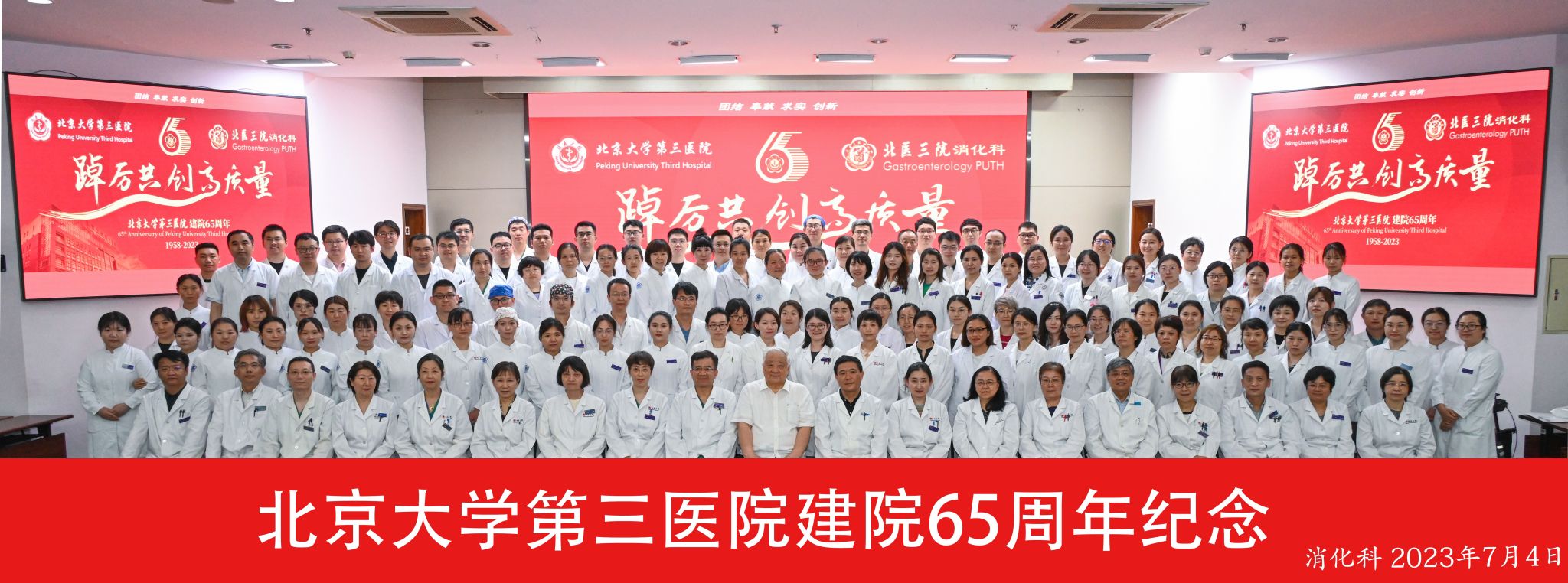
As one of the first batch of National Key Clinical Specialties, the Department of Gastroenterology at Peking University Third Hospital (PUTH) was established in 1958, at the founding of the hospital. Its predecessor was the Gastroenterology Group of the Department of Internal Medicine. Through the unremitting efforts of several generations, it has developed into the Peking University Digestive Disease Research Center, integrating outpatient services, inpatient wards, gastrointestinal radiography rooms, gastrointestinal motility laboratories, pathology laboratories, and endoscopy units. Currently, the department has over 190 staff members, including 74 physicians and 92 nurses.
At the department's inception in 1958, Professor Zheng Zhitian was transferred from Peking University First Hospital to PUTH to establish the Department of Internal Medicine teaching unit and serve as its director. He led the gastroenterology team in performing gastroscopy, diagnostic laparoscopy, and liver biopsy, making our department one of the earliest units in China to adopt gastrointestinal endoscopic examination techniques. Many renowned experts visited our department for training. The evolution of endoscopic techniques in our department mirrors the development of gastrointestinal endoscopy in China, from the earliest rigid endoscopes, semi-flexible gastroscopes, and fiberoptic gastroscopes, to electronic endoscopes, electronic chromoendoscopes, magnifying endoscopes, and blue laser endoscopes. Each technological advancement and successful leap embodies the countless days, nights, and efforts of our predecessors.
In September 1984, with approval from Peking University and PUTH leadership, the Department of Gastroenterology was separated from the Department of Internal Medicine to become an independent department at PUTH, with Professor Li Yinong serving as department director. In 1985, with support from the Ministry of Health and Peking University leadership, the department established a clinical experimental base covering 300 m². The facility comprised two floors: the first floor housed the endoscopy unit, equipped with advanced diagnostic and therapeutic devices including electronic endoscopes, endoscopic ultrasound, and laparoscopic ultrasound; the second floor housed laboratories, including pathophysiology, biochemistry, and cell biology units. The establishment of this research base was rare in China at the time and laid the foundation for the department's development.
In May 1985, with approval from Peking University, the Peking University Digestive Disease Research Center was established, marking the formation of a complete, independent medical, educational, and research system encompassing dedicated outpatient services, emergency care, inpatient wards, endoscopy units, laboratories, and X-ray examination facilities, providing favorable conditions for the rapid advancement of the discipline. Professor Li Yinong fully assisted Professor Zheng Zhitian and made substantial contributions to the establishment and development of the Digestive Disease Center.
In 2006, the endoscopy unit's floor area was expanded to over 600 square meters. In 2007, with investment from Fujinon Corporation, the department established an Endoscopy Training Center, becoming a national standardized endoscopy training base for gastroenterologists. At the end of 2016, it became one of the first national ERCP training bases. Currently, the endoscopy unit is equipped with the following advanced devices: electronic endoscopy processors, Doppler electronic endoscopic ultrasound systems (radial, linear, and mini-probe), capsule endoscopy, electronic double-balloon enteroscopy, new-generation electronic colonoscopes, new-generation electronic duodenoscopes, endoscopic ultrasound micro-probes, ultra-slim transnasal gastroscopes, electronic magnifying endoscopes with FICE system, and endoscopic blue laser imaging diagnostic systems. The department's pathology laboratory is equipped with Nikon 80i microscopes and Nikon SMZ1500 stereomicroscopes. The gastrointestinal radiography room is equipped with advanced equipment such as the Toshiba digital gastrointestinal X-ray system.
In 2012, the department's bed count increased from the original 31 to 39, and in 2014, it expanded to two wards with a total of 60 beds. A new endoscopy center was inaugurated in 2012. Over the years, the Department of Gastroenterology at PUTH has pioneered numerous "firsts" in domestic endoscopy: in 1974, it took the lead in performing ERCP; in 1982, it pioneered magnifying endoscopy and single-operator colonoscopy; in 1985, it took the lead in endoscopic ultrasound; in 1991, it pioneered endoscopic treatment for early gastric cancer; and in 1995, it was the first to perform percutaneous endoscopic gastrostomy. These advanced techniques and equipment have resolved numerous complex clinical diagnostic and therapeutic challenges. In 2009, the department became a National Key Clinical Specialty. While advancing endoscopic techniques, the department successively established gastrointestinal radiography and digestive pathology laboratories. In 1978, the PUTH Digestive Disease Research Laboratory, including the digestive pathology unit, was founded, with Professor Ye Simao making significant contributions to the establishment of the pathology laboratory. In 1980, Professor Lin Sanren introduced Japan's air-barium double-contrast radiography technique to our department, providing a powerful tool for early gastric cancer detection and making our department the first in China to adopt this technique. The superiority of this technique has been maintained to this day, particularly for small intestinal air-barium double-contrast radiography, with numerous patients still referred to our hospital from other regions and many renowned Beijing hospitals. Professor Zheng Zhitian initiated the establishment of the digestive pathology laboratory at the hospital's founding, introducing laboratory techniques advanced in China at the time, such as parietal cell antibody and alpha-fetoprotein testing. The integration of gastric mucosal biopsy findings with gastroscopic observations was a domestic innovation, bringing benefits to clinical patients.
In the early 1980s, the department established its development philosophy of subspecialty group-oriented advancement driving overall departmental growth, creating the upper gastrointestinal group, colorectal group, small intestinal group, liver disease group, gastrointestinal radiography group, and pathology laboratory group. Subsequently, the gastrointestinal motility group and biliopancreatic disease group were established. The advanced management concepts and outstanding academic achievements attracted domestic colleagues for advanced training. In 1981, the department held its first national gastroenterology advanced training course, followed by annual courses, training numerous physicians for various institutions nationwide. These achievements received assistance and recognition from international colleagues, with renowned Japanese endoscopy experts, the late Professor Takemoto Tsuneyoshi and Professor Shirabe Hikoo, visiting our hospital multiple times during the 1980s and 1990s to lecture and demonstrate advances in Japanese endoscopy and gastrointestinal radiography.
The upper gastrointestinal group, guided by clinical problem-solving and employing clinical research methodologies, has conducted numerous internationally and domestically leading clinical scientific studies while advancing clinical techniques, achieving remarkable results. In the 1970s, Professor Zheng Zhitian of our department first discovered the efficacy of furazolidone in treating peptic ulcers, pioneering the use of antibiotics for ulcer disease, which received the Beijing Municipal Science and Technology Progress Award (Second Class) in 1988 and the Ministry of Health Science and Technology Progress Award (Third Class) in 1989. Beginning in 1986, Professor Lin Sanren led the "Research on New Methods for Early Diagnosis of Gastric Cancer," which consecutively received National Seventh Five-Year and Eighth Five-Year Key Research Project funding. This led to the development of a sequential gastric cancer screening method suited to China's national conditions, earning the Ministry of Health Science and Technology Progress Award (Third Class) in 1991 and the Guanghua Science and Technology Fund Award (Third Class) in 1992. In 1996, Professors Lin Sanren and Zhou Liya initiated a 10-year follow-up study on the relationship between Helicobacter pylori and gastric cancer in a high-incidence area in Shandong Province, making China's contribution to clarifying the relationship between H. pylori and gastric cancer. Since 2006, Professor Zhou Liya has consecutively undertaken National Eleventh Five-Year and Twelfth Five-Year Science and Technology Support Program projects, achieving breakthrough progress in H. pylori diagnosis and treatment. These achievements received the Ministry of Education Science and Technology Progress Award (Second Class) in 2014 and the Chinese Medical Association Science and Technology Progress Award (Second Class) in 2015. Professor Ding Shigang, with support from the Beijing Natural Science Foundation-Haidian Original Innovation Joint Fund, developed a light-field 3D confocal endoscope for diagnosing early esophageal and gastric cancer. Under the National Key Research and Development Program of the Ministry of Science and Technology, he conducted clinical application validation of high-definition electronic endoscopy and research on tumor intervention and efficacy evaluation based on nano-molecular imaging probes. In 2015, the department was approved as the Beijing Key Laboratory for H. pylori Infection and Upper Gastrointestinal Disease Diagnosis and Treatment Research.
Professor Lin Sanren of our department took the domestic lead in performing endoscopic retrograde cholangiopancreatography (ERCP) on April 26, 1974. Therapeutic ERCP techniques, including endoscopic sphincterotomy (EST) for stone extraction, began in 1993. In 2004, when Professor Huang Yonghui joined our department, the Biliopancreatic Disease Group was formally established. In addition to routine ERCP diagnostic and therapeutic techniques such as bile duct stone extraction, stent placement for benign and malignant extrahepatic bile duct strictures, and pancreatic duct stent placement, the Biliopancreatic Disease Group has conducted numerous innovative clinical research studies since its inception, developed multiple domestically advanced new techniques, and obtained several national utility model patents, some of which have entered the clinical translation phase. Members of the group have undertaken and participated in numerous national and provincial/ministerial research projects, including National Science and Technology Support Program projects, National Natural Science Foundation of China grants, National Key Research and Development Program "Major Chronic

 English